What does “breeding for health” mean?
Before talking about breeding for health, we first need to discuss the types of health issues faced by French Bulldogs in the first place.
Frenchies are what’s called a brachycephalic dog breed. This means the shape of their face causes issues with their breathing, which in turn makes them more prone to heat exhaustion, asthma, and even stress-induced heart attacks. On a day-to-day basis, brachycephalic dogs can struggle to breath, with their faces so pushed inwards they simply cannot draw in enough air for what their body needs.
French Bulldogs are also a miniature dog breed, which means their legs have been systematically shortened and truncated as they were bred smaller and smaller. This increases their risk of patella luxation, although small dogs can generally get away with a lot of patella issues without pain or disability.
They have been bred to be a “cobby” dog, which means shortened. Not only are they short in height, but they’re short in length too. Their spines were bred shorter and shorter, until they developed a distinctive curvature. At the same time, a deformity developed which significantly shortened their tails, creating their iconic “pigtail” look. In the 1800’s the effects of these characteristics weren’t understood, but now that we have x-rays and CT scans, we do know. The shortened spine and munted pigtail causes their spinal bones to become deformed, significantly increasing the risk of IVDD and other spinal issues.
Frenchies were also selectively bred for broader heads and shoulders and a narrow hip. This trend has now become quite extreme, to the point that over 90% of French bulldog litters are born by caesarean section, because bitches cannot give birth to the fat-headed puppies through their narrow-hipped birth canal.
So, what do we do about these issues? It’s easy for someone to add the slogan “breeding for health” on their French Bulldog breeder profile, or on their website, but what does that actually boil down to?
Longer faces
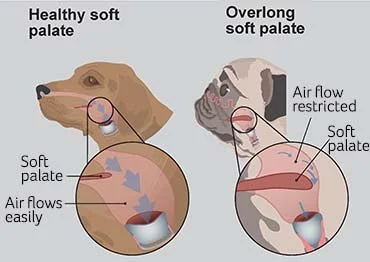
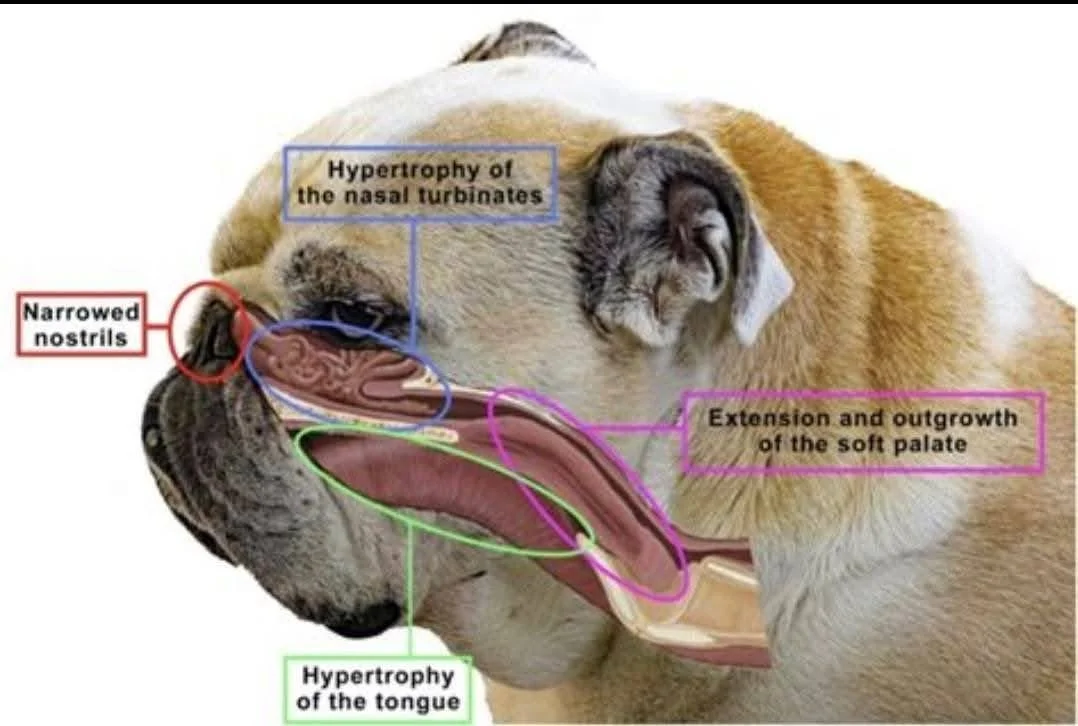
The most obvious thing that needs to be changed in the French Bulldog is the length of their muzzle. On the outside of a dog’s face is their muzzle, but on the inside is the palate and soft palate (the roof of the mouth). The length of a dog’s soft palate is set primarily by their physiology, and it’s been very slow to adapt to the shortening of the French Bulldog’s face. When the muzzle gets shorter, the soft palate stays the same length and ends up pushed back further into their heads, over the windpipe. The shorter the face, the more the soft palate is pushed across the windpipe, until it hits the interior skull bones; until there’s simply no room left for air to move past it and into their lungs. That’s not even taking into consideration the tongue, which also has difficulty fitting inside an every increasingly short face. The nasal passages are also compressed by the extreme shortening of their faces. The skin on the interior of the nasal passages becomes puckered and folded by the same muzzle-shortening effect, and their external nostrils are narrowed. So, when a Frenchie breathes, air doesn’t circulate cleanly, nor easily, into and out of their lungs. It becomes turbulent and has to be dragged into the lungs by the bellows of their diaphragm. In turn, this struggle to pull air in puts pressure on the soft palate, which becomes thickened and elongates further, increasing their respiratory distress. The constant sucking pressure to bring air into their lungs in turn puts stress on the windpipe, which can lead to collapse of the trachea (especially in older age).
The solution to this is simple: make their faces longer. Instead of breeding with the shortest muzzle in the litter, breed with the longest. It doesn’t have to be a significant change, as every little bit helps. At present, a “well-bred and structurally correct” French Bulldog has a CFR (cranial facial ratio) of 0.1. If that increases to 0.3 they are no longer considered a brachycephalic dog breed, but even an increase to 0.2 would make a world of difference to their ability to breathe. Not every dog with a CFR of 0.2 or 0.3 will have perfect breathing, but they are vastly improved on the squashed faces of the past. For the last ten years, we at Tralinka French Bulldogs have been breeding with progressively longer and longer faced dogs. We now rarely produce any pups who show signs of respiratory distress, and none of our breeding dogs have had nor required BOAS surgery.
A balanced dog
The trend for French Bulldogs to have very large heads and shoulders, disproportional to the size of their hips, has been a relatively modern one. Photos of Frenchies from the early 1900’s show them to be a lot narrower, and longer, than their modern counterparts. The extremes of today are only possible due to modern medical science, and a willingness for vets to perform elective caesareans for anyone who wants that for their dogs. In a lot of cases, it’s physically impossible for a French Bulldog bitch to give birth to their own puppies. Their hips (and birth canal) are simply too narrow for the big heads and shoulders of the pups they produce. This unbalanced body shape also makes the French Bulldog very front heavy and far more likely to land on their head when they jump, even just from couch height. It decreases their ability to swim, because they can’t keep those fat heads up out of the water when all they want to do is topple head first into the drink. This need for caesareans has become so ingrained in the culture of French Bulldog breeding, that no one even thinks of it as unusual. It’s simply the way things are done. But it’s a practice that is not sustainable, and nor is it healthy for our dogs. This is nature’s way of saying stop, when bitches cannot whelp their own pups, but hardly anyone is paying attention.
By returning the French Bulldog’s size to what it was a hundred years ago, we go back to the balanced and proportional dogs they were, where the bitches whelped their own babies and the males could have sex without assisted intervention. When a Frenchie could run and play and jump and twist to their heart’s content, without risking bodily harm or even death. Shown here is a photo of a French Bulldog from early 1900’s, alongside one of our own longer-spined and longer-faced French Bulldogs. Today this is seen as “incorrect”, yet a century ago it was a show-winning Frenchie. Our girl pictured here whelped each of her litters naturally, without the need for a caesarean, and she mothered all her babes perfectly
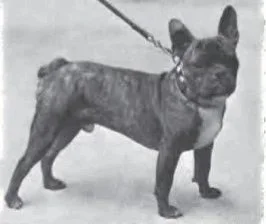
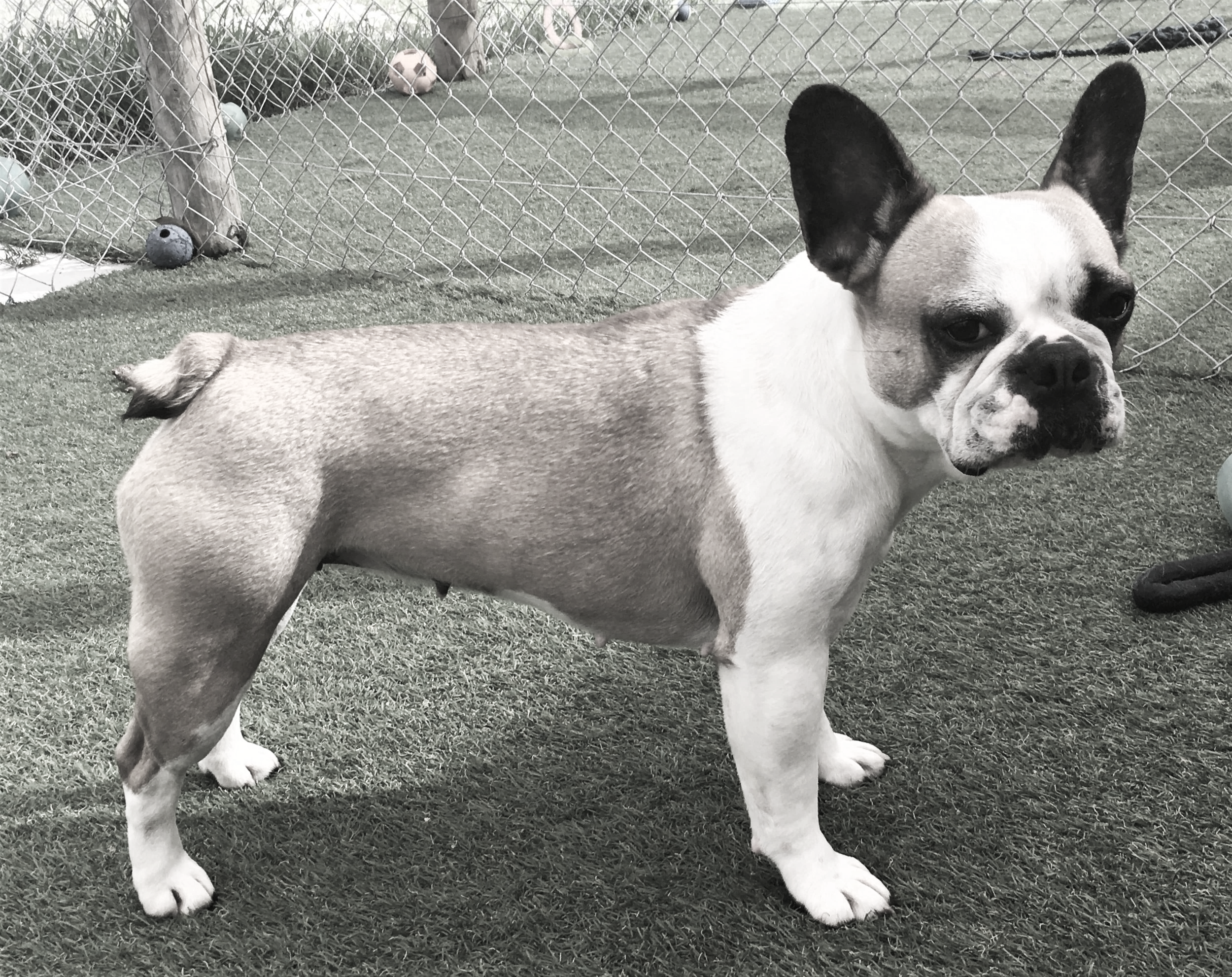
Comparison between a French Bulldog from early 1900’s, to one of our girls in 2020. Showing longer spines, more balanced heads and no thick necks.
Longer tails and spines
The most significant change to the appearance of the French Bulldog in recent years has been with the lengthening of their tails. When the short little snub tails first began appearing within the French Bulldogs in the 1800’s, breeders saw it as cute, and unusual, and very desirable. No one knew how these little screwtails were affecting the dogs on the inside. X-rays hadn’t been invented back then. But now we know. Those cute little corkscrew tails cause spinal deformities throughout their entire back, as well as skull changes, and increases the risk of hydrocephalus, spina bifida, cerebral palsy, paralysis, slipped disc, and IVDD. To name but a few.
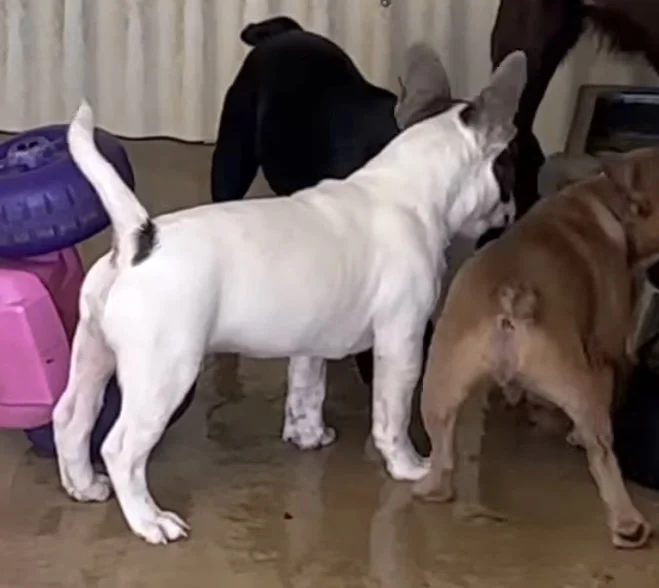
The DNA of the screwtail has now been identified as a deformity on the DVL2 gene. The good news is that it’s a recessive gene and breeding it out is easier than for a dominant gene. Also, the bad news is it’s a recessive gene: which means any dog with a screwtail has no clear genes to give to their offspring. Thankfully, a few single copy DVL2 dogs have been identified amongst the pedigree French Bulldog population, and the fight is now on to widen this limited gene pool as far as possible, across the globe.
With the elimination of the screwtail gene, the vast majority of the spinal issues suffered by French Bulldogs have been eliminated. Gone are the hemivertebrae and malformed spinal bones. Gone is the abnormally curved spine and the short, cobby look. Now they have a spine length appropriate to their size, with each bone well-formed and healthy. Taking the screwtail out of the French Bulldog has done more to improve their health than any other single change any breeder has made so far. Going forward, all matings we shall be doing at Tralinka French Bulldogs will be with long-tailed dogs. We are proud to be a part of the DVL2 gene elimination breeding program.
There’s more to a dog than DNA
While this is certainly true, DNA testing does offer us a window into the makeup of our dogs. Although it does annoy me to no end when breeders proclaim their dogs “healthy” because they’ve had a DNA test proving them to be free of the common genetic diseases/conditions associated with French Bulldogs. This does not make them healthy!! This means they are not going to suffer from the particular diseases that DNA testing has cleared them for. A DNA test does not mean they won’t get BOAS, or hip dysplasia, or arthritis or cancer, or any of the other hundred things that can happen to a dog over the course of their lives. It also does depend on exactly what sort of DNA test was performed, and how many additional items were tested for. DVL2, IVDD, CDDY, ADAMTS3. These are some of the important ones, which many breeders conveniently forget about, simply because such a high percentage of French Bulldogs are affected. It’s just too hard to find clear dogs to breed with, so they don’t even bother trying.
DVL2 we have already spoken about above, so I won’t repeat myself here.
IVDD (Intra-Vertebral Disc Disease) and CDDY (Chondrodystrophy). This is essentially two connected genes that increases the risk of dogs developing degeneration of the spinal discs at a very young age. Chondrodystrophy is similar in many ways to dwarfism, although it is not dwarfism. It causes a shortening of the limbs, and since French Bulldogs are a miniature breed, I don’t think this is something which will be eradicated in the short term. Like the Dachshund, the French Bulldog is a short-limbed breed, and this is unlikely to change. The connected gene, IVDD, can cause a debilitating and often fatal condition. When the spinal discs degenerate, this damages the spine and spinal cord. A very high percentage of French Bulldogs have two copies of this gene, which is an unintended byproduct of the preference for rounded ears. Apparently single or no copy IVDD dogs tend to have pointed ears (which I can kind of see there being a possibility for a connection, since the spinal discs are made of cartilage, same as the ears). Being affected by two copies of the IVDD gene does not mean a dog will be affected by disc disease, but it does increase the risk. Breeding this gene out of Frenchies is certainly a worthwhile endeavour. It won’t be easy, especially for those already working to eliminate DVL2 as well, but it is possible.